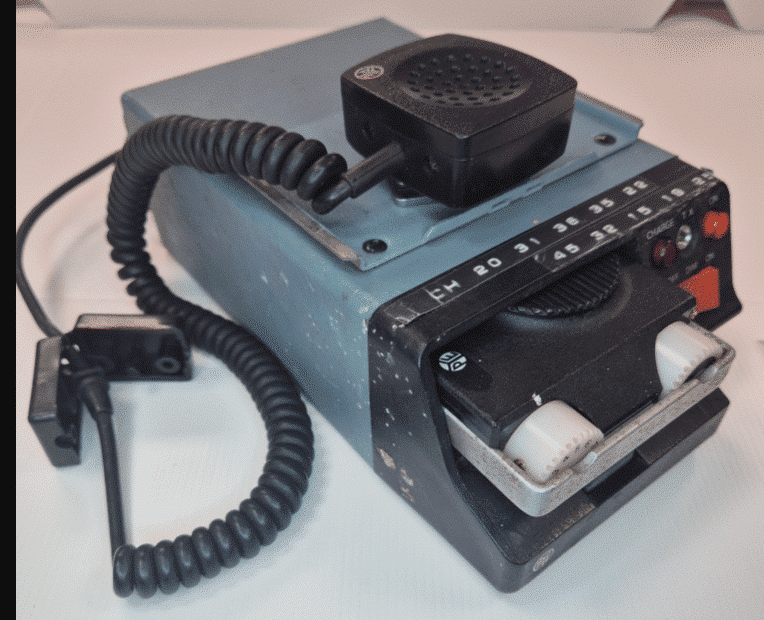
First personal radio type
Surrey Police first introduced authentic personal radios in 1968. They were the PF1 Pocketfone, made by Pye of Cambridge. It was a two-unit hand held device with a ‘pop up’ rod aerial and was a single channel radio.
Soon after their introduction, there was a call for having multi-channel personal radios and a less unwieldy two-part radio system.
In the early 1970s, the Burndept BE439/BE470 models, combined the receiver and transmitter parts and had 3 selectable channels. They remained in use into the 1980s. Each radio had 3 batteries assigned with it: one in use, one on charge and one spare.
In 1975, another radio system: the Pye PF6 was introduced into Force. This was routinely fitted into dog section vehicles and had a mobile adapter, allowing portability for larger area coverage and foot patrols.
1980s
In the 1980s, personal radios were developed further and doubled in channel capacity.
The BE660 PR personal radio model had six channels, but the 1984 miner’s strike showed that even 6 channels were limiting.
Seconded officers from Surrey Constabulary had to ‘recrystal’ their radios for use in the Nottingham Force area (- each channel used a different crystal to switch frequencies -) and it quickly became apparent that there was a demand nationwide for more channels per device.
99 channels
In 1989, 2 manufacturers began supplying 99 channel personal radios to Police Forces nationwide: the Motorola HT600E and the Philips PFX.
These radios saw the use of a frequency synthesiser, instead of the traditional crystals for each channel. These remained in use until the early 2000s.
Digital systems
In the 2000s, the ‘Airwave’ radio network – a digital system – was introduced nationwide.
Surrey Police migrated to the new digital system which offered encryption and national interoperability.
Today, the technology largely remains the same since the introduction of digital, with just some minor aesthetic changes for ease of use and adaptations to uniform requirements.
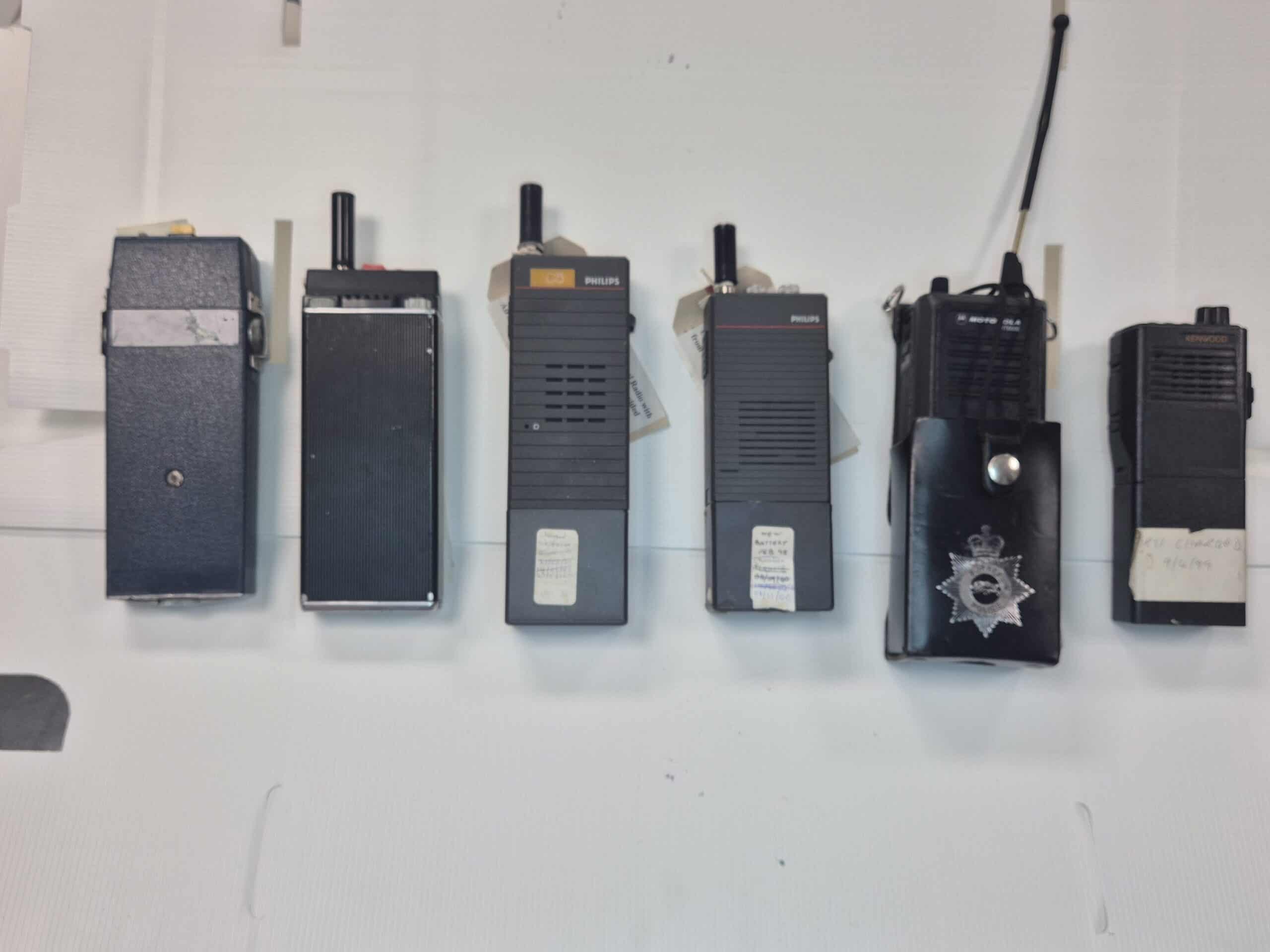
Personal radios through the years: (Left to right):
- Burndept BE470 (1970s)
- Burndept BE600 (1980s)
- Philips (Pye) PFX (1989 to 2000)
- Philips (Pye) PF85 covert (1989 to 2000)
- Motorola HT600E (1989 to 2000s)
- Kenwood TK5400 (trialled in 1999)
Latest News
Have your say on crime and policing where you live as the Policing Your Community roadshow returns

A total of 12 Policing Your Community events will take place in each of Surrey's 11 boroughs, as well as online.
Criminals stealing razors and Champagne are being brought to justice, Commissioner says after TV show tracks investigation
A Channel 5 TV show filmed a Surrey Police investigation into an organised criminal group targeting supermarkets.
Deputy Commissioner says Forcer Protocol to find missing veterans is “fundamentally the right thing” for Surrey
The Forcer Protocol, which has launched in Surrey, aims to ensure missing veterans can be quickly found by police officers.